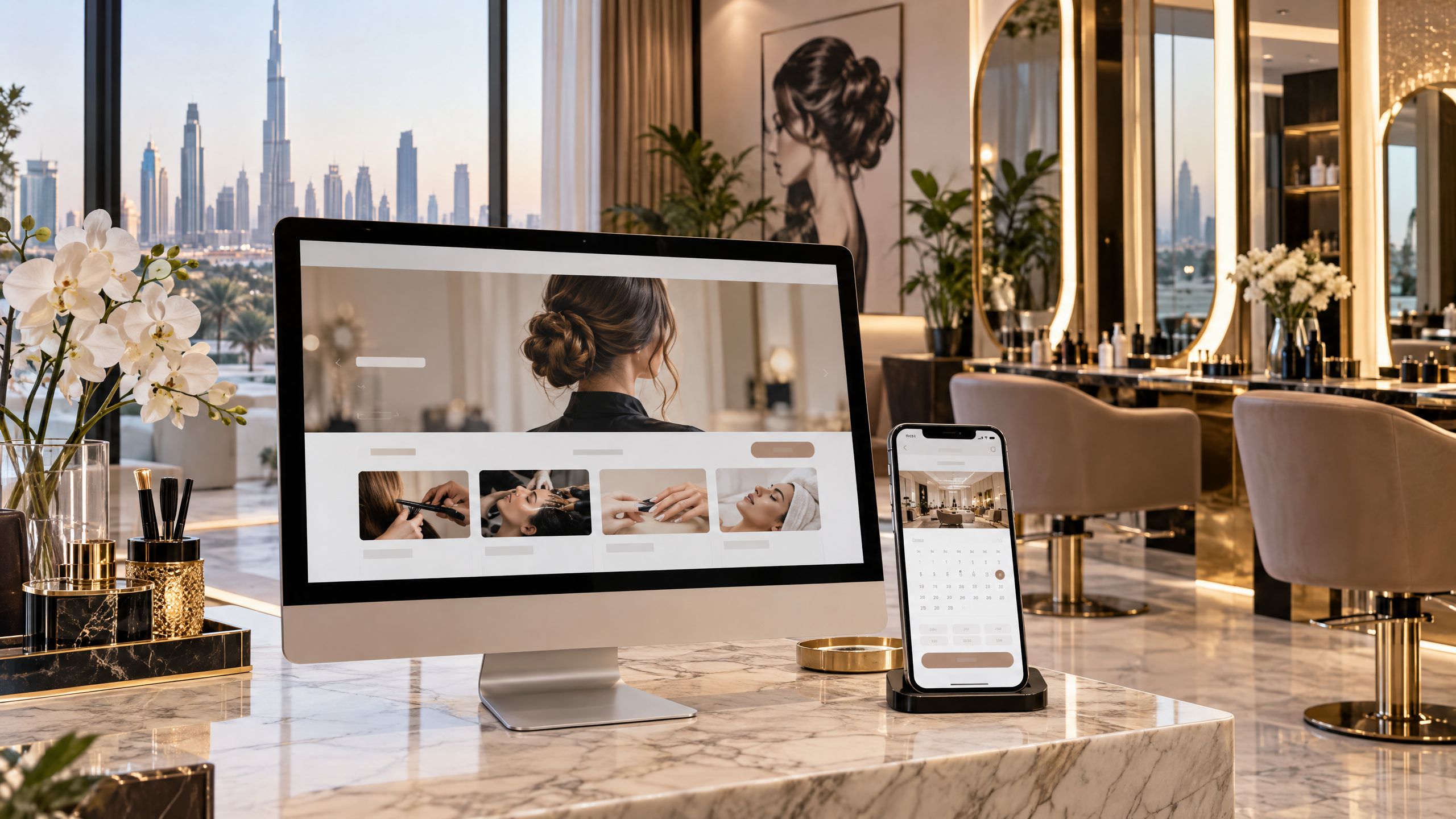
Businesses in the beauty and personal-care sector compete on more than service quality. People compare nearby options, check reviews, browse social media, ask questions, and expect a convenient booking experience. For salon owners, beauty centres, barbershops, nail studios, spas, and salon managers across Dubai and Abu Dhabi, digital marketing works best when each channel supports the same journey: discovery, confidence, enquiry, booking, and a reason to return.
For a business targeting salon website design Dubai, the goal is not simply to collect clicks or followers. It is to attract the right local audience and make it easy for people to understand the service, verify important details, and take the next step. A practical strategy connects website content, local listings, social media, advertising, messaging, and reporting.
This guide provides an actionable framework. Results depend on competition, service mix, location, capacity, budget, and execution; no tactic can guarantee rankings, enquiries, or revenue.
Why a connected digital journey matters
Many businesses use several channels without connecting them. Instagram may show attractive work, Google may list an old phone number, the website may contain an outdated service menu, and WhatsApp enquiries may wait unanswered during busy periods. Each issue seems minor, but together they create friction and can lead potential clients to choose another provider.
Give each channel a clear job:
- Search and maps help people discover nearby businesses when they are actively looking.
- The website explains services, credentials, location, practical details, and booking options.
- Social media demonstrates the experience, shares useful education, and keeps the brand familiar.
- Messaging and booking tools help people ask administrative questions and select an appointment.
- Follow-up and reporting show which activities contribute to business outcomes.
The central principle is simple: keep public information accurate, give each call to action a clear destination, and assign responsibility for every new enquiry.
Services and prices that are easy to find
Start with the basics before increasing marketing spend. Review what a new visitor sees on a phone. Can they understand the service in a few seconds? Is the business name consistent? Can they find the correct location, hours, contact method, and next step? Fixing basic friction often matters more than adding another platform.
Create a baseline audit:
- Search for the business name and main services on Google.
- Check the website and social profiles on a mobile device.
- Test the booking or enquiry journey from start to finish.
- Ask someone unfamiliar with the business to find a service and request an appointment.
- Record broken links, outdated information, confusing steps, and unanswered questions.
Do not assume that an attractive post or high traffic figure means the customer journey is working. Check whether people can move from discovery to a meaningful enquiry.
Mobile appointment journeys
Build pages and content around the questions people genuinely ask. A useful page explains what a service includes, who provides it, where it is available, how to enquire, and what practical conditions apply. Avoid repeating the same keyword unnaturally. Write for clarity, then include local wording where it helps people and search engines understand the page.
For example, a page targeting salon website design Dubai should provide genuine information relevant to that search, not just repeat the phrase. Related pages may address beauty salon website Abu Dhabi, online salon booking UAE, or salon booking website if the business actually offers the relevant service or serves that area. Do not create pages for locations where the business has no real presence.
A useful service page generally includes:
- A clear title naming the service and relevant location.
- A concise explanation of what is offered.
- Accurate availability, booking details, and limitations.
- Answers to common questions.
- Relevant team, facility, or service information.
- One primary call to action and an easy contact option.
Trust through real business details
Trust is built through details that can be checked. Keep the business name, address, opening hours, service menu, contact details, and booking links consistent across the website and listings. Use genuine photography and current information. If credentials or professional qualifications matter, present them accurately and do not imply approvals or capabilities the business does not hold.
Reviews help people understand the experience, but they should be collected ethically. Invite genuine customers to share honest feedback after a visit. Do not offer rewards in exchange for positive ratings or ask only satisfied customers. Respond professionally to criticism, move private matters offline, and never reveal customer or patient information in a public reply.
For aesthetic and healthcare settings, trust also means responsible communication. Do not guarantee outcomes, misrepresent qualifications, or publish personal images without valid permission. Keep service menus and prices accurate, and confirm that every advertised service is within the business’s permitted scope.
Booking, WhatsApp and analytics
Content should answer useful questions and show the real experience of the business. Create a repeatable monthly plan instead of relying on last-minute posts. Useful formats include:
- Service explainers that set realistic expectations.
- Introductions to the team and relevant experience.
- Answers to frequently asked questions.
- Behind-the-scenes content showing the environment and process.
- Seasonal or locally relevant service information.
- Booking guidance, opening-hour updates, and reminders.
- Genuine customer feedback shared with permission and in line with applicable rules.
Use English and Arabic where those languages serve your audience. Do not rely on automatic translation for technical, clinical, or sensitive information without a fluent reviewer. Each caption should make sense on its own, use location references naturally, and tell the reader what to do next.
Short videos can show the atmosphere, explain a process, and introduce staff. Use clear audio, stable framing, accessible captions, and one main idea per clip. The aim is not to chase every trend; it is to help the right audience understand why the business is relevant.
Simple website maintenance
Choose a small set of metrics and review them consistently. Useful measures include:
- Relevant website visits and service-page engagement.
- Calls, message clicks, booking starts, and completed bookings.
- Enquiry-to-booking rate.
- Attendance and cancellation rate, where available.
- New versus returning clients.
- Cost per qualified enquiry and cost per attended appointment for paid campaigns.
- Review volume and response time.
- Revenue or contribution margin from promoted services.
Set up tracking before scaling spend. Use analytics and platform reporting where appropriate, and test that conversions are recorded correctly. Avoid treating every click as a lead or every lead as a sale. For privacy-sensitive sectors, collect only necessary information, restrict access, and follow consent and applicable privacy requirements.
A practical 30-day action plan
Week 1 — Audit and repair. Check listings, website details, mobile usability, contact buttons, booking links, and service descriptions. Fix inaccurate information before increasing promotion.
Week 2 — Improve the core journey. Update important service pages, make the main call to action obvious, prepare replies for common administrative questions, and decide who owns new enquiries.
Week 3 — Publish useful content. Create a small batch of service explainers, team introductions, FAQs, and location-relevant posts. Ensure images and testimonials are authorised for use.
Week 4 — Measure and refine. Review the questions people asked, the pages they visited, enquiry sources, and the share of enquiries that became bookings. Improve the weakest step before expanding the campaign.
This sequence keeps the workload manageable for a small team and creates a baseline for better decisions.
Example: remove friction from the booking journey
Imagine someone searches for salon website design Dubai, opens the business profile, checks the website, and wants to book. If the profile lists one phone number and the website lists another, the visitor has to resolve the mismatch. If the booking link opens a generic homepage, the visitor must find the service again. If a message is unanswered until the next day, interest may fade.
The improved journey is straightforward: accurate profile details, a page that matches the search, a visible booking option, clear confirmation, and a sensible follow-up. The business can record the source and outcome without asking for unnecessary personal information.
For example, a salon in Al Reem Island may need to make its service menu, opening hours, language options, and appointment availability easy to find. A clinic in Dubai Marina may need to separate its service information from practitioner profiles and consultation booking details. Local needs vary, so use actual enquiry patterns rather than assumptions.
Common mistakes to avoid
Promoting every service at once. Start with the services that fit the business, have capacity, and matter commercially. Focused campaigns are easier to measure.
Sending all traffic to the homepage. Match the destination page to the service and message that attracted the visitor.
Using discounts as the only message. Promotions may create short-term interest but can weaken positioning if they become the whole strategy. Explain convenience, service quality, expertise, and experience accurately.
Ignoring enquiry handling. Marketing cannot compensate for missed messages, unclear availability, or inconsistent follow-up. Assign responsibility and set realistic response expectations.
Copying competitors. Competitor research can reveal what customers compare, but copying their language and creative does not create a distinctive offer. Build around real strengths.
Reporting vanity metrics only. Reach and likes can be useful diagnostic indicators, but owners also need to understand qualified enquiries, bookings, retention, and margin.
Frequently asked questions
How long does digital marketing take to show results?
Paid campaigns may generate enquiries sooner when the offer, targeting, landing page, and follow-up process are ready. Organic search generally requires sustained work. Timelines vary with competition, website condition, service demand, budget, and execution.
Should a business focus on Google or Instagram first?
Start with the biggest gap. If local information is incomplete, repair it first. If search visibility is strong but awareness and social content are weak, social media may deserve more attention. Many businesses use both for different purposes.
Is a website necessary if customers book through WhatsApp?
A website can explain services, provide searchable information, and answer questions before a conversation begins. WhatsApp is useful, but it should not have to carry every detail that could be explained clearly on a service page.
What should a business expect from a marketing agency?
Expect a documented plan, defined deliverables, clear reporting, transparent separation of media spend and management fees, and regular discussion of lead quality and business outcomes. No agency can responsibly guarantee rankings or sales without accounting for external factors.
How Digital Miraj can help
Digital Miraj supports businesses in Dubai, Abu Dhabi, and across the UAE with website design, local SEO, digital advertising, social media content, and conversion-focused digital experiences. A practical engagement starts with an audit of the current customer journey, followed by prioritised improvements and reporting tied to meaningful enquiries.
If your business wants a clearer online presence and a more organised way to attract local customers, request a consultation at digitalmiraj.com. Bring your main services, target areas, current marketing activity, and desired outcomes so the discussion has a practical starting point.
Final implementation checklist
- Is every public business detail accurate?
- Can visitors understand the service and next step quickly?
- Does each campaign lead to a relevant page?
- Are enquiries assigned and answered consistently?
- Are claims, content, and images approved for use?
- Can you connect marketing activity to bookings and business value?
Digital marketing becomes easier to improve when the basics are reliable, the message is clear, and performance is judged by the customer journey—not by activity alone.
Additional planning notes for owners and managers
Before committing more time or budget, write down the business objective in one sentence. It might be to increase first-time appointments for a specific service, improve bookings during quieter weekdays, build awareness in a nearby community, or help existing customers rebook. A precise objective makes it easier to choose channels and avoid measuring unrelated activity.
Define the audience in practical terms: service need, decision questions, relevant location, preferred language, booking habits, and operational limitations. Avoid assumptions based only on age or gender. Use genuine enquiry patterns and feedback where available, and do not infer sensitive personal characteristics.
Review the offer and capacity together. Promoting more demand than the team can serve can damage the customer experience. Confirm opening hours, staff availability, appointment length, service scope, and how delays or rescheduling are handled. If demand is uneven, a campaign for suitable time slots may be more useful than a broad promotion.
For a small team, document repeatable tasks in a simple operating sheet. Include who checks messages, who updates listings, who approves posts, who monitors campaign spend, and who reviews results. A short weekly review is often more sustainable than a complex report nobody uses. Record decisions and the reason behind them so the team can learn from each test.
When comparing marketing suppliers, ask what is included in the monthly fee and what is charged separately. Clarify content volume, photography or video production, landing-page work, reporting frequency, campaign ownership, account access, and cancellation terms. The business should retain appropriate access to its website, analytics, advertising accounts, and customer information.
Test improvements one at a time where possible. If you change the offer, creative, targeting, landing page, and follow-up process simultaneously, it becomes difficult to identify what made a difference. Record the change date, compare an appropriate period, and account for seasonality, public holidays, staffing, and service availability. Small, documented tests create a stronger foundation than chasing a new tactic every week.
A reliable marketing system is not necessarily complicated. Listings provide consistent information, social content answers real questions, campaigns have a defined audience and destination, enquiries have an owner, and reporting identifies both volume and quality. When something underperforms, inspect the entire journey instead of automatically increasing the budget.
For UAE businesses, local relevance also means respecting differences between emirates, neighbourhoods, language preferences, and licensing requirements. Use the actual service area, make bilingual information accurate where needed, and check current rules before publishing regulated claims or promotions. For clinical services, marketing teams should work with the clinic’s authorised professionals on service descriptions and approvals.
The best next step is therefore not always a new campaign. It may be correcting a listing, simplifying a booking page, clarifying a service menu, or improving follow-up. Prioritise the change most likely to remove a real obstacle, measure what happens, and build on the evidence.
Related DigitalMiraj guides
- Aesthetic Clinic Website Design in Abu Dhabi and Dubai: Trust Before Conversion
- SEO for Salons in Dubai and Abu Dhabi: How to Attract More Local Clients
- Beauty Salon Branding in the UAE: Build a Recognisable Local Identity
DigitalMiraj: DigitalMiraj is an Abu Dhabi digital solutions company helping organisations connect digital marketing, AI integration, branding and enterprise software through practical workflows.