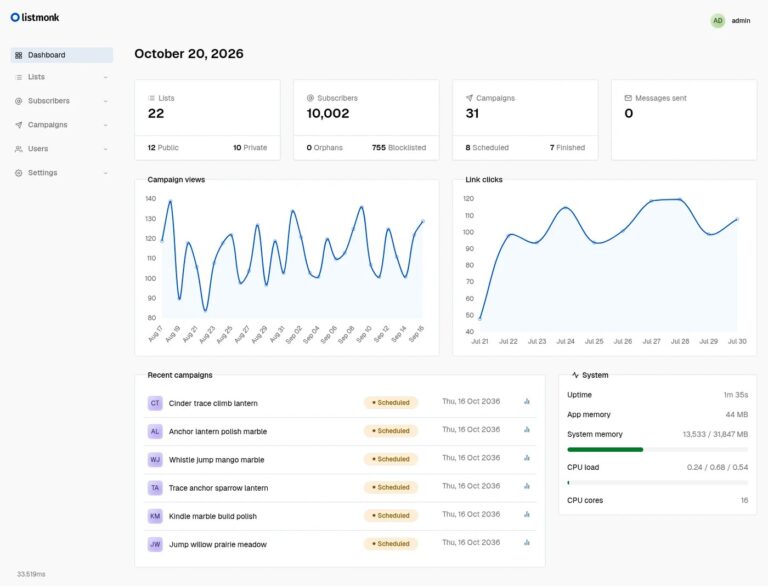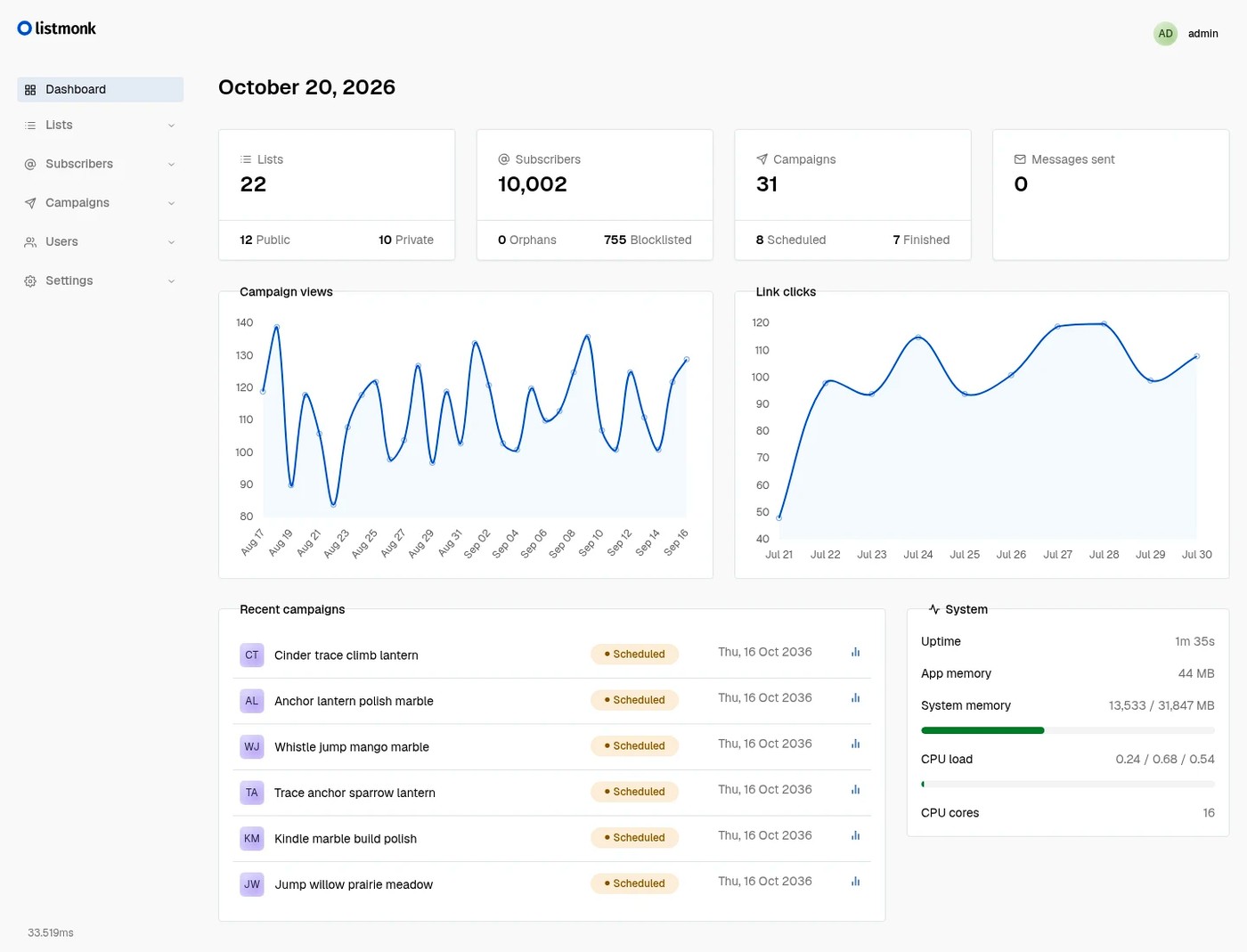
Short answer: Listmonk can reduce recurring email marketing software costs because it is free, open-source, and self-hosted. Instead of paying a large per-contact or per-send subscription to a SaaS platform, your business pays for the infrastructure, email delivery provider, monitoring, and technical management it actually needs. For companies sending internal updates, newsletters, alerts, and high-volume transactional messages, that can provide more control and a clearer long-term cost structure.
However, “open source” does not mean “no cost.” A reliable setup still needs a server, PostgreSQL, an SMTP or email delivery service, domain authentication, backups, bounce handling, security updates, and someone responsible for operations. The financial advantage comes from removing the software licence and reducing dependence on a vendor’s audience-based pricing—not from ignoring the work required to deliver email responsibly.
What is Listmonk?
Listmonk is a self-hosted newsletter and mailing-list manager. The official project describes it as a high-performance application distributed as a single binary, with PostgreSQL as its database. It is free and open source under the AGPLv3 licence, and it supports subscriber lists, campaigns, segmentation, templates, analytics, APIs, and transactional messages.
That model is different from a typical hosted email marketing platform. With a SaaS service, the provider runs the application and usually charges according to contacts, sends, features, or a combination of those factors. With Listmonk, your team runs the application in an environment you control. You can use a virtual private server, a private cloud, a managed hosting provider, or an internal infrastructure environment that meets your security and operational requirements.
How an open-source platform can save money
1. No recurring software subscription
The most direct saving is the absence of a recurring Listmonk software licence. This matters when a company has a large database or sends frequent messages. Many hosted platforms increase their monthly price as subscriber numbers grow. A self-hosted application does not automatically become more expensive simply because your list becomes larger, although delivery infrastructure and operational requirements may increase.
The right comparison is not “SaaS price versus zero.” It is “SaaS subscription plus provider limits versus infrastructure, delivery, and support costs under your control.” A business in Abu Dhabi, Dubai, Colombo, Toronto, Sydney, or Melbourne can choose a hosting and email-delivery arrangement that fits its compliance, latency, budget, and volume needs.
2. More predictable costs for growing lists
Listmonk supports multiple lists and subscriber segmentation. That can be useful when one organisation manages customer newsletters, partner communications, employee updates, product announcements, and service notifications. Instead of opening several paid SaaS accounts or moving to a more expensive tier, the organisation can structure these audiences inside one platform.
Predictability still depends on good design. Your team should estimate active subscribers, monthly campaign sends, peak transactional volume, attachment and media needs, database growth, and delivery-provider charges. A simple monthly cost model should include hosting, SMTP or API delivery, backups, monitoring, domain services, maintenance, and support.
3. Lower switching and integration friction
Listmonk exposes an API and supports integrations. Its transactional API can send arbitrary messages using predefined templates, while messenger interfaces can extend delivery to channels such as SMS or WhatsApp when configured with the appropriate provider. This makes it possible to connect forms, CRM systems, applications, ecommerce workflows, or internal tools without rebuilding every process inside a proprietary marketing platform.
For example, a business could connect a website subscription form to a Listmonk list, trigger an onboarding email from an application, segment subscribers by market, and send an operational update to a defined audience. The exact workflow depends on the application and consent model, but the platform gives developers a flexible foundation instead of locking every step into one vendor’s interface.
Where Listmonk fits: newsletters, internal email, and transactional messages
Marketing newsletters
Listmonk is designed for one-way mailing lists and campaign management. Teams can create lists, import subscribers, use single or double opt-in, build templates, schedule campaigns, and review performance data such as opens, clicks, bounces, and top links. This makes it suitable for educational newsletters, product updates, event invitations, customer education, and B2B communications.
Internal communications
Companies can also use a self-hosted platform for internal announcements, departmental updates, staff newsletters, training notices, and partner communications. Internal use does not remove the need for permission, accurate lists, unsubscribe handling where applicable, access control, and secure administration. It does make it easier to separate internal audiences from public marketing audiences and to retain control of templates and data flows.
Transactional email
Transactional messages are triggered by an action or event. Examples include account verification, password assistance, order updates, appointment reminders, invoice notices, onboarding steps, and service alerts. Listmonk’s official documentation includes a transactional messaging API and predefined templates for this purpose.
Transactional email should be designed separately from promotional email. It needs clear event triggers, reliable delivery, useful logging, retry behaviour, bounce processing, and a sender identity that recipients recognise. For mission-critical notifications, your architecture may need a dedicated delivery provider or a secondary route rather than relying on one untested server.
What you still need to budget for
Self-hosting shifts responsibility rather than eliminating it. A professional Listmonk deployment normally needs:
- Application hosting: a suitable server, operating system, network access, storage, and capacity planning.
- PostgreSQL: Listmonk uses PostgreSQL as its data store, so database backups, upgrades, and recovery procedures matter.
- Email delivery: an SMTP relay or email API with appropriate sending limits, reputation controls, and regional availability.
- Domain authentication: SPF, DKIM, and DMARC configured for the sending domain, plus correct DNS records.
- Operations: monitoring, bounce processing, log review, patching, access control, and incident response.
- Compliance: consent records, unsubscribe handling, privacy notices, retention rules, and a process for access or deletion requests.
This is why a low-cost deployment can become an expensive problem if nobody owns maintenance. The goal is not to run the cheapest possible server. The goal is to create a dependable email system whose total cost is proportionate to the value and volume of the messages it sends.
Regional considerations for UAE, Australia, Canada, and Sri Lanka
A regional deployment should reflect the audience and the business environment. A UAE company serving customers in Abu Dhabi and Dubai may need clear consent records, Arabic-ready workflows for human-reviewed campaigns, and hosting and delivery choices that fit its internal policies. The official UAE Digital Government portal provides broader context on the country’s digital transformation and regulatory framework.
For Australian, Canadian, and Sri Lankan audiences, the same operational principles apply: document consent, identify the sender, make unsubscribe easy for marketing messages, protect subscriber data, and avoid sending irrelevant or excessive campaigns. International teams should also consider time zones, local spelling and language preferences, data-transfer requirements, and whether a single global list or market-specific lists are easier to govern.
Listmonk supports internationalisation and flexible templates, but the platform cannot decide whether a campaign is legally appropriate. That decision belongs to the business and its advisers. Technical configuration should support the organisation’s privacy and marketing policies rather than replace them.
Listmonk versus a hosted SaaS platform
| Area | Listmonk | Hosted SaaS |
|---|---|---|
| Software cost | Free and open source | Recurring subscription is common |
| Infrastructure | Managed by your team or partner | Managed by the provider |
| Data control | Greater control over hosting and storage | Dependent on provider policies |
| Scaling cost | Driven by infrastructure and delivery volume | Often driven by contacts, sends, or plan tier |
| Customisation | API, templates, SQL segmentation, and integrations | Limited to platform features and permitted integrations |
| Support burden | Requires internal expertise or a technical partner | Provider support and managed updates |
Listmonk is usually a strong fit when you have technical ownership, meaningful sending volume, a need for integration flexibility, or a preference for controlling the application environment. A hosted SaaS platform may be better when your team wants a fully managed service, needs advanced campaign design without technical support, or sends relatively small volumes where subscription costs are not a concern.
A practical setup path for a business
- Define the use cases: separate newsletters, internal messages, transactional events, and operational alerts.
- Map the data: document subscriber sources, consent status, fields, lists, segments, retention, and deletion workflows.
- Select the infrastructure: choose hosting, PostgreSQL, backups, access controls, and a delivery provider.
- Authenticate the domain: configure SPF, DKIM, DMARC, sender addresses, tracking domains, and bounce handling.
- Build templates: create responsive, accessible email templates for each audience and message type.
- Test before sending: verify API triggers, opt-in and unsubscribe flows, links, rendering, deliverability, and failure recovery.
- Monitor and improve: review bounces, complaints, clicks, delivery rates, system logs, and campaign performance.
Can DigitalMiraj help you set up Listmonk?
DigitalMiraj can help businesses plan and implement a self-hosted email marketing and transactional messaging system around Listmonk. As an Abu Dhabi-based digital solutions company serving the UAE, Sri Lanka, Australia, Canada, and international teams, DigitalMiraj can support requirements mapping, infrastructure planning, Listmonk installation, PostgreSQL configuration, SMTP and DNS setup, template creation, API integrations, list migration, security controls, monitoring, and ongoing technical support.
The right architecture depends on your audience size, sending frequency, application workflows, compliance requirements, and internal technical capability. Explore DigitalMiraj’s integration services or contact the DigitalMiraj team to discuss a practical setup for your business.
Frequently asked questions
Is Listmonk completely free?
Listmonk is free and open-source software under the AGPLv3 licence. You still pay for hosting, email delivery, domain services, backups, monitoring, maintenance, and technical support.
Can Listmonk send transactional emails?
Yes. Listmonk provides a transactional messaging API and template-based sending. The application that triggers the event and the delivery configuration still need to be designed and tested.
Is Listmonk suitable for UAE businesses?
It can be suitable for UAE businesses that want control over their email system and have a clear plan for consent, security, domain authentication, hosting, and delivery. Local legal and privacy requirements should be reviewed for each use case.
Does self-hosting mean there are no email limits?
No. Your practical limit depends on your server, email delivery provider, sending reputation, rate limits, list quality, and operational controls. Self-hosting removes some software-plan limits but does not remove delivery constraints.
Should transactional and marketing email use the same setup?
They can share the application platform, but they should use separate lists, templates, permissions, sending policies, and monitoring. Separating message types helps protect important transactional delivery from campaign problems.
Where can I read the official documentation?
Start with the official Listmonk documentation, especially the installation, configuration, templating, integrations, bounce processing, and transactional API sections.
Last updated: November 2026. Product capabilities and third-party delivery pricing can change, so confirm the current Listmonk documentation and provider terms before implementation.