Sam Altman in Abu Dhabi: Why AI’s Future Depends on Energy
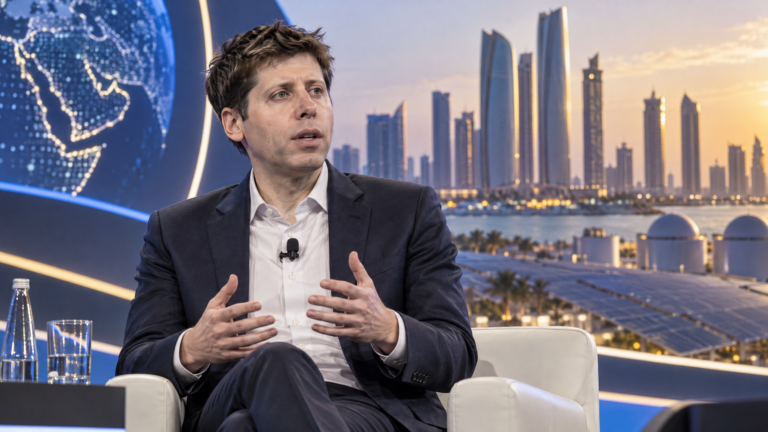
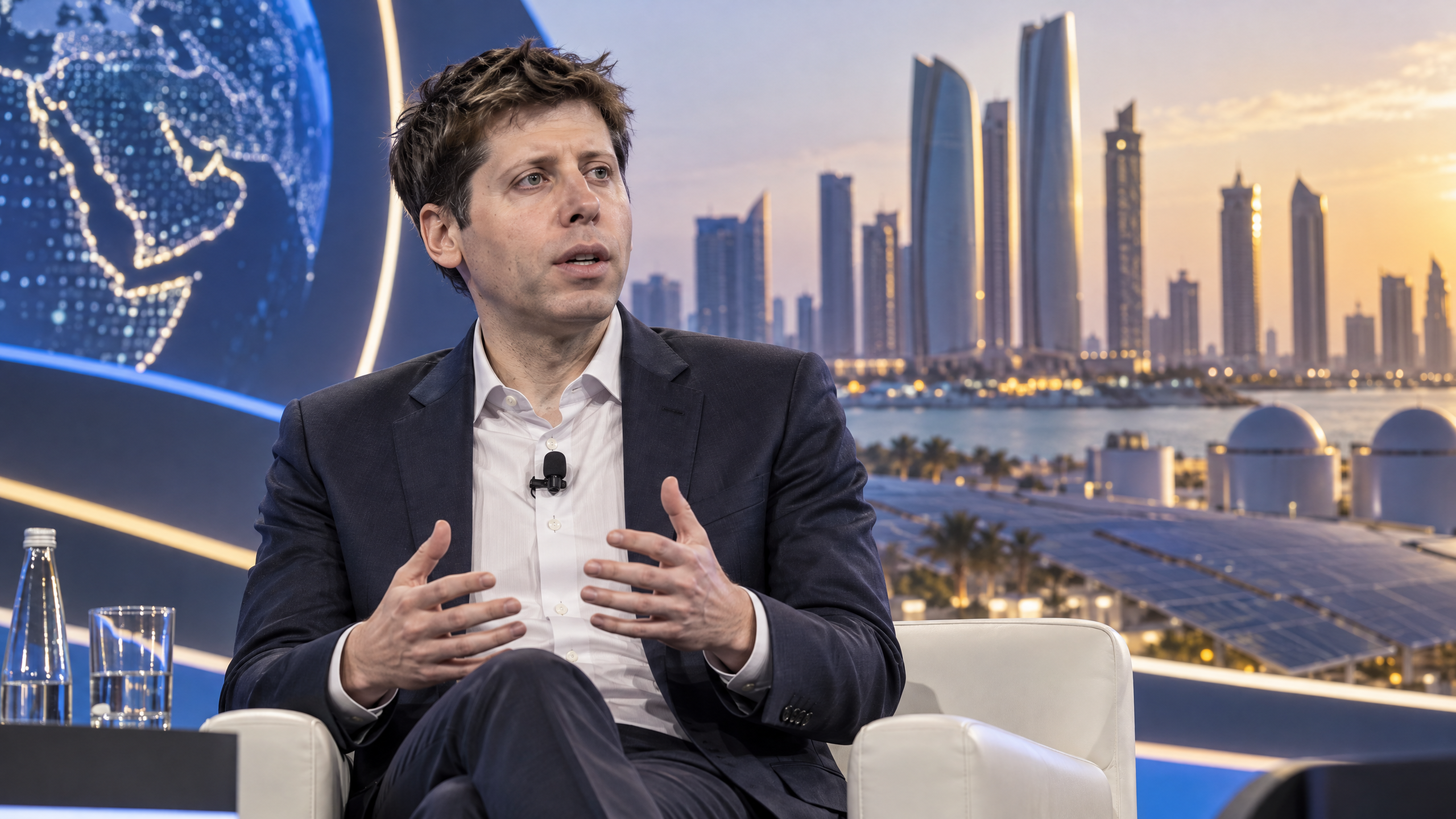
Sam Altman’s visit to Abu Dhabi for ADIPEC 2026 showed why the next phase of artificial intelligence will be shaped as much by energy and infrastructure as by software. The OpenAI chief executive joined discussions about AI’s potential in the energy industry while Abu Dhabi announced agreements involving OpenAI, ADNOC, G42, the Abu Dhabi Government and Mubadala. The message was clear: the UAE is moving from talking about AI adoption to deploying it across strategic sectors, with energy at the centre of that transition.
What happened during Sam Altman’s Abu Dhabi visit?
On 2 November 2026, Altman attended the opening of ADIPEC in Abu Dhabi and met Sheikh Khaled bin Mohamed bin Zayed Al Nahyan, Crown Prince of Abu Dhabi and Chairman of the Abu Dhabi Executive Council. According to the Abu Dhabi Media Office, the meeting was followed by four agreements between Abu Dhabi-based entities and OpenAI.
The agreements cover four connected areas:
- Energy: ADNOC, G42 subsidiary Inception42 and OpenAI agreed to deploy OpenAI’s frontier technology across ADNOC’s operations. ADNOC says it will become the first energy company to deploy OpenAI Frontier.
- Government: Abu Dhabi Government and OpenAI launched a machine-readable government initiative designed to help AI systems interpret policies and regulations while keeping officials responsible for final decisions.
- Investment: Mubadala, Inception42 and OpenAI agreed to apply advanced AI to investment analysis, opportunity identification and risk assessment.
- Enterprise and education: Inception42 and OpenAI signed a five-year agreement to support frontier AI adoption across government, enterprise and education in the UAE.
Together, these agreements present AI as an operating capability rather than a standalone technology experiment. The intended use cases include connected operational decisions, commercial analysis, regulatory assistance, investment research and wider organisational adoption.
Why energy was the central theme
The most important idea in Altman’s remarks was also the most practical: advanced AI needs a great deal of electricity, data-centre capacity and physical infrastructure. AI companies can improve model efficiency, but they cannot eliminate the need for real-world power systems.
Reuters reported Altman describing energy as one of OpenAI’s challenges. He said that the physical world powering AI would be a dominant factor in its cost and abundance. He also said OpenAI’s most advanced models would be used to address “the hardest, most valuable problems” facing ADNOC.
At ADIPEC, Altman also argued that AI can help the energy sector improve itself. ITP reported his concise formulation: “Now AI can benefit energy.” The point is not simply that energy companies will buy more computing. AI could help researchers explore new materials, engineers improve industrial equipment, operators identify risks and businesses make faster, better-informed decisions.
That creates a feedback loop. AI requires more energy, but better AI may help the energy industry produce, move and manage energy more efficiently. The UAE’s opportunity is to participate on both sides of that equation by combining its energy expertise, infrastructure investment, sovereign capital and technology partnerships.
What ADNOC’s agreement could mean in practice
The ADNOC partnership is significant because it links frontier AI to a large, complex industrial operating environment. The Abu Dhabi Media Office says the deployment will support more connected operational, investment and commercial decision-making. The agreement is also intended to strengthen efficiency and productivity across ADNOC’s operations.
The official announcement identifies in-country inference infrastructure in the UAE. That matters for organisations that need to consider data residency, security, latency and operational control. It also reflects a broader shift in enterprise AI: companies are increasingly asking not only which model is most capable, but where the model runs, how data is governed and who remains accountable for decisions.
The energy use cases described by Abu Dhabi officials include field development, well management and commercial operations. These are high-value environments where AI outputs must be tested against engineering knowledge, operational safeguards and human judgment. The value of the partnership will therefore depend on implementation quality, not only model capability.
Altman’s warning: humans must remain in control
The Abu Dhabi visit was not presented as an unqualified technology celebration. In a discussion reported by Khaleej Times, Altman stressed that humans must remain in control of increasingly powerful AI systems. He argued that decisions about society’s future should not be left to technology companies alone.
That principle is especially important when AI moves into energy, government and investment. A system may assist with a permit review, identify an investment opportunity or recommend an operational action, but assistance is not the same as authority. Abu Dhabi’s machine-readable government initiative reflects that distinction by making assessments traceable to the governing rule while retaining official oversight and accountability for final decisions.
Altman also acknowledged that AI could disrupt employment and change how people work. His position, as reported by Khaleej Times, was that technological progress can create opportunities while requiring individuals and institutions to adapt. For organisations in the UAE, this means AI planning should include training, role redesign, approval processes and risk controls—not just software procurement.
What the UAE is signalling to global businesses
The Abu Dhabi agreements send three signals to businesses watching the region.
First, the UAE wants to be an implementation market for advanced AI, not only a source of capital or a host for data centres. The agreements span public administration, energy, investment, education and enterprise services.
Second, the country is treating infrastructure as part of AI strategy. Models, chips, data centres, electricity, connectivity, security and skilled people must develop together. Altman’s energy comments make that dependency explicit.
Third, responsible deployment is becoming part of the commercial proposition. The official Abu Dhabi announcement describes a shared commitment to “safety, accessibility and responsible innovation.” That is more than a communications phrase when AI is applied to public rules, energy operations and capital allocation. Businesses will need governance that explains what AI can recommend, what it cannot decide and how humans can challenge or reverse an output.
Summary: Abu Dhabi’s AI story is becoming operational
Sam Altman’s Abu Dhabi visit was meaningful because it connected the global AI race to the UAE’s strongest strategic assets: energy, infrastructure, capital, government coordination and long-term investment. The ADNOC-G42-OpenAI agreement is the most visible example, but the wider package of four agreements is more revealing. It shows Abu Dhabi pursuing AI across the systems that shape an economy.
The central lesson from ADIPEC 2026 is that AI and energy are now inseparable. AI needs energy to scale, while AI may help the energy industry become more efficient, resilient and intelligent. The strongest deployments will be those that combine advanced models with local infrastructure, sector expertise, transparent rules and accountable human decision-making.
For UAE organisations, the question is no longer whether AI will affect operations. It is how to identify valuable use cases, prepare reliable data, build governance and help people work effectively with increasingly capable systems.
“Abu Dhabi and the UAE are setting a bold, global standard for AI integration across both the public and private sectors to make sure the benefits of AI reach everyone.” — Sam Altman, quoted by the Abu Dhabi Media Office
Sources
- Reuters: Abu Dhabi’s ADNOC, G42 sign deal with OpenAI as Sam Altman travels to UAE
- ITP.net: Sam Altman at ADIPEC 2026: Why the UAE’s AI Ambitions Depend on Energy
- Khaleej Times: Humans must remain in control of AI, says OpenAI CEO Sam Altman
- Abu Dhabi Media Office: Khaled bin Mohamed bin Zayed meets Sam Altman and witnesses signing of agreements with OpenAI
- Abu Dhabi Media Office: Dr Sultan Ahmed Al Jaber delivers opening address at ADIPEC 2026