When someone in Abu Dhabi searches for a nearby consultant, compares service providers in Dubai, or asks a colleague for a recommendation, the business they discover online has an opportunity to earn attention and trust. Digital marketing is the work of making that discovery useful: helping the right people find a business, understand what it offers, and take a sensible next step.
For a UAE business, that may mean appearing for a local search, explaining a service clearly on a website, answering questions on social media, or following up with a customer who has agreed to receive updates. It is not simply posting often or buying advertisements. It is a planned way to connect business goals with customer needs across digital channels, then learn from the results.
💡 What digital marketing means
Digital marketing is the use of online channels and digital technology to introduce, explain, promote, and sell products or services. Common channels include websites, search engines, online advertising, social networks, email, messaging, and video. These channels can help a business reach people before a purchase, support their decision, and continue the relationship afterwards.
For example, an Abu Dhabi air-conditioning company might publish a clear page about annual maintenance, make sure its business details are accurate on maps, and run a search advertisement for people actively looking for maintenance. A visitor can read the service terms, request a quotation, and later receive a reminder if they opted in. Each activity supports a stage in the customer journey; none works well if the service page is confusing or the enquiry is ignored.
Digital marketing is not the same as “being on the internet.” A website that nobody can find, a social account without useful information, or an advertisement that reaches the wrong audience may generate little business value. The objective is not activity for its own sake. The objective is a relevant, helpful interaction that can lead to a measurable outcome.
🧭 How it differs from traditional marketing
Traditional marketing can include outdoor signs, print, radio, television, events, and direct mail. Digital marketing uses internet-connected channels. The difference is not that one is automatically better or cheaper. A roadside sign can work well for a local venue, while a search page can help a customer who is already looking for a specific service. Many businesses use both.
Online channels often make it possible to adjust audience, creative, timing, or budget more quickly than a printed campaign. They can also record actions such as visits, form submissions, calls, and purchases when tracking is properly configured. That does not mean every result is immediate or perfectly attributable. People may discover a business on one channel, return through another, and complete a purchase later. Tracking can also be affected by consent settings, device changes, browser restrictions, and implementation errors.
Think of a campaign as a conversation across several moments, rather than one advertisement doing everything. A short social video may introduce a brand. A useful article may answer a question. A search result may bring a ready-to-buy customer to a service page. A clear quotation form may help them act. Digital marketing is strongest when those pieces make sense together.
🎯 Why UAE businesses use digital marketing
Customers in the UAE can compare providers, read reviews, watch demonstrations, and contact businesses from a phone or computer. A dependable digital presence makes basic information easier to find: what the company does, where it operates, how to contact it, what a service includes, and what the customer should expect next. This matters to a small neighbourhood provider as much as to a company serving multiple Emirates.
Digital channels also allow a business to distinguish local demand from broader interest. A company may want enquiries from Abu Dhabi city, a particular area of Dubai, or all Emirates where it can actually deliver. Geographic settings, location pages, service-area information, and campaign reports can help guide that choice. They are useful only when the business can fulfil the promise being advertised.
Another benefit is learning. A business can compare which pages attract qualified enquiries, which campaigns bring completed bookings, and where visitors leave the process. Measurement can inform better decisions, but it is not an automatic return-on-investment guarantee. Results depend on the offer, competition, customer experience, budget, timing, and the quality of the data.
🔎 1. Search engine optimisation (SEO)
SEO is the practice of improving a website so search engines can understand its pages and people can find useful answers. It includes technical basics, clear page titles, descriptive headings, helpful content, fast and mobile-friendly experiences, and meaningful links between related pages. Good SEO begins with the customer’s question, not a list of keywords repeated unnaturally.
Suppose a Dubai-based accounting firm wants to reach small companies that need VAT support. It could create a page explaining which services it provides, who it serves, how an initial consultation works, and how to get in touch. A separate article might answer common questions in plain language. If the business genuinely serves Abu Dhabi too, it should explain that accurately rather than copying the same page and changing only the city name.
Google’s own guidance says there is no secret that automatically places a site first. Search engines need time to discover and assess changes, and results are not guaranteed. Useful, original, readable content and a technically accessible site are stronger foundations than tricks. For a deeper service overview, see [DigitalMiraj’s SEO service page](https://digitalmiraj.com/digital-marketing/seo/).
📍 2. Local search and business listings
Local marketing helps people discover businesses in a place or service area. It often combines a well-organised website with accurate map listings, consistent business information, genuine customer reviews, and location-aware service details. A business profile should reflect the real business: its recognised name, eligible location or service area, appropriate categories, opening hours, phone number, and website.
For example, a home-repair company in Abu Dhabi should describe the areas it actually covers and show a phone number that customers can use. A Dubai clinic should make its address, appointment process, and hours easy to confirm. If an organisation has multiple eligible branches, each should have accurate information for that branch. Adding city names to a business name when they are not part of the real-world name can create policy problems rather than useful visibility.
Local relevance is not created by inserting “Abu Dhabi” or “Dubai” into every paragraph. Build genuinely useful pages for the services and locations served. Explain local availability, travel limits, languages supported, and any practical differences in the service. Google’s [Business Profile guidelines](https://support.google.com/business/answer/3038177?hl=en) emphasise accurate real-world representation, precise addresses or service areas, and using only the categories needed to describe the core business.
💳 3. Paid search and online advertising
Paid advertising lets a business pay to show a message on search engines, social networks, websites, or video platforms. Search ads can be useful when a person is already looking for a service. Social and display ads can introduce an offer to people who may not yet be searching. The buying model varies: some campaigns charge by clicks, others by impressions or other defined outcomes. “Pay-per-click” is one model, not a rule for every online advertisement.
Imagine a Dubai training provider offering a short professional course. It might run a search campaign for people searching for that exact course, while showing a separate awareness video to a broader professional audience. Each campaign needs a clear goal, relevant landing page, sensible geographic targeting, exclusions where appropriate, and a budget the company can afford to test. A click is not the same as a qualified lead or a sale.
Before increasing spend, check that forms, calls, or purchases are recorded correctly. Google Ads conversion measurement can use a page load for simple actions or code and event data for more complex actions such as button clicks or variable purchase values. Poor setup can produce duplicate or misleading reports. Learn more about [Google PPC advertising](https://digitalmiraj.com/marketing/google-ppc/).
📱 4. Social media marketing and advertising
Social media marketing includes publishing useful organic content, responding to questions, and using paid promotion where it fits. The best platform depends on the audience and the type of decision. A business-to-business consultancy may value professional networks and detailed case examples. A restaurant may benefit from appetising short videos, location details, and timely updates. Neither should assume that one platform reaches everyone.
For a café in Abu Dhabi, a practical content mix could include a menu update, a short video showing a new dish, a post with accurate opening hours, and thoughtful responses to customer questions. A Dubai property maintenance company might share before-and-after project explanations, seasonal maintenance tips, and a clear enquiry route. These examples are not a promise of results; they illustrate how useful information can fit a channel and an audience.
Paid social can extend the reach of selected content or support a specific campaign. Measure the action that matters: qualified enquiry, booking, purchase, or another defined goal. Likes and views can help diagnose creative performance, but they should not be treated as revenue by themselves. A consistent tone, honest claims, and a realistic response process help protect trust.
✍️ 5. Content marketing
Content marketing is the planning and sharing of useful material that helps a defined audience understand a topic, solve a problem, or make a decision. It can include articles, guides, checklists, videos, case studies, webinars, and short social posts. Content is not useful just because it is long. It should answer a real question with accurate, clear information and a suitable next step.
A UAE-based IT provider could publish a plain-language guide that explains how a small company can prepare for a cloud migration. It can define unfamiliar terms, list the information to gather, explain likely trade-offs, and state what is outside the guide’s scope. A case study could then describe a real project with permission and verifiable details. This kind of content helps a reader assess expertise without relying on unsupported claims.
One detailed guide can be adapted into shorter posts, a video outline, or an email newsletter, provided each version is tailored to its format. Do not copy the same paragraph everywhere and expect it to perform equally. Keep a review date for material that can change, such as pricing, software features, regulations, or service availability. See [content marketing services](https://digitalmiraj.com/marketing/content-marketing/) for related support.
✉️ 6. Email and messaging
Email can deliver newsletters, product information, event updates, and service reminders to people who have a reason to receive them. It is particularly useful for maintaining a relationship after a first interaction. A good email has a recognisable sender, a clear subject, one main purpose, readable formatting on a phone, and an easy way to manage preferences or unsubscribe where required.
For example, a Dubai design studio might send a monthly email with one practical branding tip and a link to a recent project. A training company could share course dates with people who asked to hear about future sessions. Sending a large list frequent generic promotions is not a substitute for relevance, and the fact that an address is publicly visible does not automatically make every use appropriate.
Messaging and SMS can be useful for timely updates, such as appointment confirmations or delivery notifications. Separate operational messages from promotional messages, respect the permissions and channel rules that apply, and avoid sending more often than customers expect. Keep records of how contact details were collected, what people agreed to, and how opt-outs are handled. For email and SMS planning, see [DigitalMiraj’s email marketing service](https://digitalmiraj.com/digital-marketing/e-mail/).
🎥 7. Video, influencer, and affiliate marketing
Video can demonstrate a process, show how a product works, or answer a question that is difficult to explain in a short text. A 40-second video showing how a service appointment is booked may remove uncertainty for a customer. Captions help people understand the video when sound is off and support accessibility. The first few seconds should make the subject clear without exaggerating what the viewer will get.
Influencer marketing involves working with a creator whose audience may be relevant to a business. Affiliate marketing typically rewards a partner for a tracked action such as a sale or lead. In both cases, choose partners for audience fit, credibility, and appropriate conduct, not just follower counts. Make commercial relationships clear and ensure that claims, testimonials, and permissions are accurate. Give partners approved facts, but do not script false personal experiences.
A local Abu Dhabi experience provider might partner with a travel or food creator to explain a real tour, including what is included, where it starts, and any conditions. A Dubai online shop might use affiliate links with clear terms. In every case, assess the actual results and protect the audience’s trust.
🧩 How the channels work together
Channels are most effective when they guide a person through a coherent path. A customer might first see a short video, search the company name, read an explanatory page, compare reviews, and then submit a form. If the ad promises a service that the landing page does not explain, the journey breaks. If the form asks for too much information or does not work on a phone, the journey breaks again.
Start by describing the customer’s path in ordinary language. What question do they have? Where might they look for an answer? What information would help them compare options? What action should they take next? Then select channels that can support those steps. A small business does not need to use every platform. It needs a few channels that it can manage consistently and measure sensibly.
For instance, a company in Abu Dhabi could publish a detailed service page, make its local listing accurate, and use a modest search campaign to test demand. If people visit but do not enquire, it can investigate whether the page answers the right questions, displays pricing or scope clearly, and makes contact straightforward before simply raising the advertising budget.
📝 A practical digital marketing plan
1. Choose a business outcome
Begin with a result that matters to the business, such as qualified enquiries, confirmed bookings, online purchases, repeat orders, or attendance at an event. “Get more engagement” is too vague unless engagement is itself a meaningful step toward the outcome. Define the desired action and how it will be counted.
2. Describe the audience and service area
Identify who is likely to benefit, what problem they are trying to solve, and what they need to know before contacting you. For a business targeting Abu Dhabi and Dubai, separate the two markets when service coverage, travel time, language, pricing, or customer needs differ. Avoid assumptions based only on nationality or demographics. Use real customer conversations and consented, relevant data.
3. Review the offer and the customer experience
Make sure the service is clearly described, the price or quotation process is understandable, and the business can fulfil demand. Check the whole enquiry path on a mobile phone. Test the contact form, call button, payment steps, confirmation message, and follow-up process. Marketing cannot fix a slow response or a confusing offer.
4. Pick channels for a reason
Use search optimisation for ongoing discovery, paid search for targeted demand testing, social content for community and demonstration, and email for permitted follow-up. The right mix depends on the buying cycle and available resources. If no one owns a channel or can respond to its enquiries, do not launch it merely because competitors use it.
5. Prepare useful messages and landing pages
Write a clear promise for each audience and channel. Explain what is offered, who it is for, what the customer should expect, and what to do next. A landing page for an Abu Dhabi service should state whether the provider serves the customer’s area, rather than leaving them to infer it from an image or an ad headline.
6. Set up measurement before launch
Define the key events to track, such as a completed booking or submitted enquiry. Check that each event fires once, contains the right information, and reflects a real customer action. Avoid counting every page view as a sale. Assign campaign tags consistently and document any assumptions so that the team interprets results correctly.
7. Test, learn, and adjust
Run a manageable test, allow enough time for relevant data, and compare results with the starting point. Change one major factor at a time when possible, such as the audience, message, or landing page, so you can learn what may have made the difference. Search visibility can take time to change; paid campaign data can arrive faster but still needs context. Keep what works, improve what is weak, and stop what does not support the business goal.
🌍 Reaching customers in Abu Dhabi, Dubai, and across the UAE
Local relevance comes from accurate information and genuine service, not from repeating a place name. State the Emirates, cities, neighbourhoods, or service areas you actually cover. If your team serves only part of Dubai, say so. If a customer must visit a location in Abu Dhabi, provide a reliable address and directions. Make phone numbers, opening hours, and response expectations easy to find.
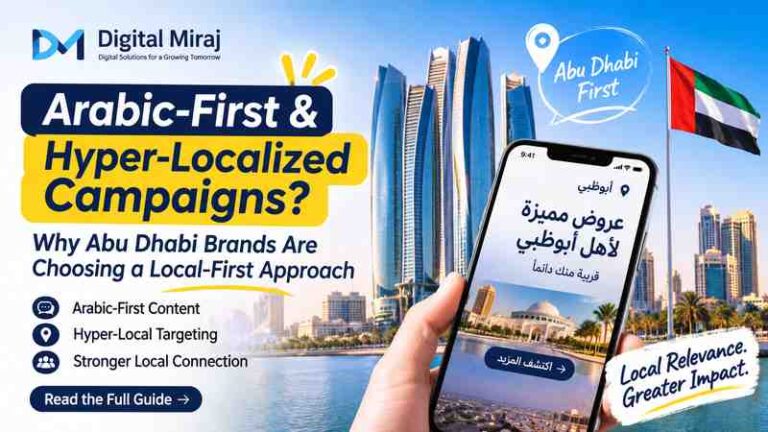
Language choice should reflect the people you want to reach and the team’s ability to serve them. English and Arabic content may both be useful for some businesses, while other audiences may prefer different languages. Translation should preserve meaning, conditions, and tone. A fluent reviewer should check important service terms, advertisements, and customer instructions before publication.
Plan around the actual calendar and operations. Public holidays, Ramadan, Eid, school breaks, trade events, and seasonal demand may affect availability or customer interest in different ways. Do not assume every customer follows the same schedule. Confirm business hours, delivery capacity, and offer conditions before promoting a time-sensitive campaign.
For a business serving several Emirates, use one consistent brand and accurate location data, then explain any real differences between branches or service areas. Do not create duplicate map profiles for a single business or list an address where customers cannot actually visit. If you have genuine branches, make the details for each one precise and current. Local search works best when a customer can trust what they find.
🤖 SEO and GEO: making information clear for search and AI answers
SEO helps search engines discover and interpret useful pages. GEO, often used to mean generative engine optimisation, is a developing label for making information easier for AI-powered search and answer systems to understand and cite. There is no reliable shortcut or guaranteed placement in either traditional search results or AI-generated answers. The practical foundations overlap: publish accurate, original information; state who is responsible for it; organise it with descriptive headings; and make important facts easy to verify.
For an article about a service in Abu Dhabi, answer direct questions in complete, simple language. Define the service, explain who it helps, name any important limits, and use locally meaningful details only when they are accurate. Add links to relevant service pages and authoritative references. Keep company details consistent across the website and business listings. Avoid writing a page solely to repeat every possible query variation.
Structured data is code that describes information already visible on a page. Article markup can help search engines interpret the headline, author, dates, and image when those details are correct. It does not guarantee enhanced search presentation or a top ranking. Google advises that markup should match the visible content and follow the guidelines for its type. Use one preferred URL for the article and a self-referencing canonical so duplicate variants can be consolidated.
📊 How to measure performance
Choose a small set of measures that connect to the goal. For a lead-generation campaign, that might include qualified leads, cost per qualified lead, lead-to-meeting rate, and sales. For an online shop, it might include completed orders, average order value, repeat purchases, and margin after advertising. For local discovery, track calls, direction requests, bookings, and enquiries where the available tools support reliable reporting.
Use web analytics and advertising platforms to understand patterns, but remember that a dashboard is a measurement system, not the full truth. Some people block tracking, decline non-essential cookies, use more than one device, or complete a purchase offline. Platforms may use different attribution rules and reporting windows. Compare data from more than one source when appropriate and use the business’s sales records to confirm commercially important outcomes.
Return on investment should account for more than clicks or impressions. Consider campaign costs, creative and staff time, discounts, fulfilment costs, cancellations, and the value of customers over time. A campaign that produces many cheap enquiries may still be weak if few are suitable. A smaller campaign with fewer but better-matched leads may create more value. Interpret results in context rather than relying on one headline metric.
🔐 Privacy, consent, and responsible marketing in the UAE
Marketing data may include a person’s name, email address, phone number, location, or online activity. Before collecting or using it, explain what the information is for, limit access, protect it, and keep it only as long as there is a suitable reason. Provide a practical way for people to manage communication preferences. Use customer data only for purposes that are permitted and consistent with what people were told.
The UAE government describes Federal Decree-Law No. 45 of 2021 on the Protection of Personal Data as a framework for processing personal data, security, confidentiality, individual rights, and cross-border transfers. Its overview says consent is required in general, subject to defined exceptions. The applicable rules can depend on the organisation, data, and jurisdiction, including whether a separate financial free-zone regime applies. Businesses should check the law and their specific obligations with qualified counsel rather than treating this article as legal advice. Read the [UAE government’s data-protection overview](https://u.ae/en/about-the-uae/digital-uae/data/data-protection-laws).
For email, SMS, forms, cookies, audience uploads, and remarketing, keep a record of the basis and permissions that apply. Do not buy contact lists and assume every person agreed to hear from you. Make promotional terms clear, honour opt-outs, and avoid misleading claims or fabricated reviews. A privacy-respecting approach is not only a compliance task; it is part of earning long-term trust.
⚠️ Common mistakes to avoid
- Trying every channel at once: Too many accounts can create inconsistent updates and unanswered messages. Start with channels that match customer behaviour and team capacity.
- Targeting an entire country by default: A campaign can waste budget if a company only serves selected areas. Set locations and exclusions to reflect real availability.
- Using vague or exaggerated claims: Explain the service, price conditions, and evidence behind claims. Promise only what the business can deliver.
- Counting activity instead of outcomes: Views and clicks may be useful signals, but they do not automatically mean a customer is interested or a sale has happened.
- Ignoring the landing page: A strong ad cannot compensate for missing service details, slow loading, broken forms, or unclear next steps.
- Using city keywords unnaturally: Repeating Abu Dhabi and Dubai in every sentence makes writing harder to trust. Use location details where they help the reader.
- Assuming a platform report is perfect: Check conversion setup, duplicate tags, attribution windows, and sales records before making major budget decisions.
- Forgetting privacy and consent: Data should be collected transparently, used for a suitable purpose, and protected. Give customers a clear way to manage marketing messages.
✅ A simple launch checklist
- Write down one business goal and the customer action that represents success.
- Define the real service area, including whether the business serves Abu Dhabi, Dubai, other Emirates, or only selected locations.
- Check that the website, local listings, contact details, and opening hours are accurate.
- Choose one or two channels that suit the customer journey and the team’s capacity.
- Make the offer, service limits, pricing or quotation process, and next step clear.
- Test the website on a phone and submit a test enquiry before spending on advertising.
- Configure and test conversion events, and make sure each action is counted correctly.
- Review privacy notices, data access, communication preferences, and promotion terms.
- Set a date to review results and document what you learn before changing the plan.
❓ Frequently asked questions
What does digital marketing include?
It can include SEO, local search, paid search and social ads, social media publishing, content, email, messaging, video, affiliate partnerships, and analytics. A business does not need every channel. It should choose the methods that help its customers find, understand, and act on its offer.
Is digital marketing suitable for a small business in Abu Dhabi?
Yes, if the chosen activities fit the business’s goals and resources. A small provider might begin with a clear website, accurate local information, a few useful posts, and one measurable campaign. Start with a manageable scope and improve it using real enquiries and customer feedback.
How long does SEO take to work?
There is no fixed timetable or guaranteed position. Search engines need time to crawl and process changes, and competition and site quality affect the outcome. Measure useful progress over time, such as relevant impressions, visits, enquiries, and the quality of those enquiries, rather than expecting an overnight result.
Does paid advertising guarantee sales?
No. Ads can help a business reach a chosen audience, but a click does not guarantee a qualified lead or a purchase. Results depend on the offer, audience, competition, landing page, budget, sales response, and measurement quality. Track meaningful actions and review the economics before scaling.
Should a UAE business create separate pages for Abu Dhabi and Dubai?
Separate location pages can help when the business genuinely serves both places and can provide useful, distinct information for each. Do not publish near-identical pages that only swap the city name. Include real differences such as service coverage, branch details, appointment arrangements, or local examples.
What is the difference between SEO and paid search?
SEO focuses on improving unpaid visibility through useful content and accessible, well-organised pages. Paid search uses advertising budget to show sponsored messages for selected audiences or searches. They can complement each other, but both need relevant pages and realistic performance expectations.
Build a plan that earns attention
Effective digital marketing in the UAE starts with a simple discipline: understand the customer, make a clear offer, show up where a useful decision is being made, and make the next step easy. For businesses in Abu Dhabi and Dubai, accurate local details and realistic service-area targeting matter as much as campaign creativity. Keep content helpful, measure outcomes with care, and treat customer data responsibly.
Businesses that need support with search, advertising, content, or social channels can explore [DigitalMiraj’s digital marketing services](https://digitalmiraj.com/marketing/) and choose an approach suited to their goals and service areas.