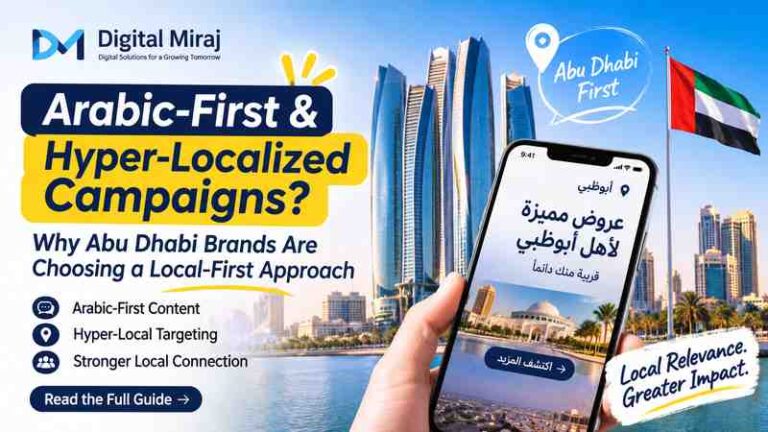
Digital marketing helps a business reach people through search, websites, social platforms, email, messaging, and other digital touchpoints. For companies in Abu Dhabi and across the UAE, the goal is not simply to appear everywhere. It is to be useful in the places customers already use, explain the offer clearly, and make the next step easy. A focused plan can support a local service business in Khalifa City, a professional firm in Al Maryah Island, a retailer in Dubai, or a company serving customers throughout the Emirates.
This guide explains the main channels in plain language, shows how they work together, and gives practical examples for UAE businesses. It also covers how to plan spending, measure results, adapt content for Abu Dhabi and Dubai, and handle customer data and advertising responsibly. No channel guarantees leads or sales. Results depend on the offer, audience, timing, execution, competition, and follow-up.
📌 What digital marketing means in practice
Digital marketing is the planned use of digital channels to help people discover, understand, choose, and continue using a product or service. It includes unpaid activity, such as useful articles and organic search visibility, as well as paid activity, such as search ads and sponsored social posts. It can also include a company website, online directory profiles, email newsletters, permission-based SMS, mobile apps, and analytics.
Consider an Abu Dhabi home-maintenance company. A resident may first see a short video showing how to identify an air-conditioning filter that needs attention. Later, the resident searches for a nearby maintenance provider, checks service areas and reviews, visits the company’s website, and asks for a quote. The marketing journey includes more than the video or the search result. The website, accurate contact details, clear prices or quote expectations, and timely reply all affect whether the resident feels confident enough to proceed.
That example illustrates an important principle: channels should support one customer journey, not operate as disconnected tasks. A social post that promises a service should lead to a page that explains that service. A form should tell the visitor what information is needed and what happens after submission. The sales or service team should know how to respond. If one of those steps is unclear, buying more advertising may simply send more people into a confusing process.
🧭 Start with the business goal and the customer
Before choosing platforms, write down the business outcome you want to improve. “Get more visibility” is too broad to guide decisions. A more useful goal might be to increase qualified quote requests for a particular service, attract registrations for a business event, encourage existing customers to book maintenance, or help a new product reach relevant retailers. The goal should describe a real business need, not just a number available in an advertising dashboard.
Next, describe the people you want to reach. A small business does not need a complicated persona document. It can start with a few practical questions: Who usually needs this offer? Where do they live or work? What problem are they trying to solve? What might stop them from contacting you? Which language would make the information easiest to understand? What proof would help them assess the offer?
For example, a business software provider in Abu Dhabi may serve procurement managers, finance teams, and business owners. Those groups may share an interest in the product but ask different questions. A finance lead might need clarity about cost and reporting. An operations manager may want to know how the system fits existing processes. A business owner may need a plain-language summary of the time, people, and support required. One generic advertisement is unlikely to answer all three sets of questions well.
Choose a clear primary action for each campaign. It could be a phone call, a booking, a request for a consultation, a product enquiry, a store visit, or a useful download. Avoid asking a first-time visitor to complete a long form if a short question or a simple call would meet the need. Make the action visible, explain what happens next, and ensure someone is responsible for handling the response.
🌐 Build a website that answers real questions
A website is often the place where a customer checks whether a business is credible and whether its offer fits. It should load reliably on a phone, use clear navigation, and explain the main services without forcing visitors to decode company jargon. Important details should be easy to find: what the business does, who it serves, where it operates, how to contact it, and what a customer can expect after making an enquiry.
Imagine a visitor in Al Reem Island looking for a nearby physiotherapy clinic. A useful page would state the clinic’s services, exact location or service area, opening information, booking method, and any relevant practitioner credentials. It should not imply that every patient will achieve the same outcome. The visitor can then decide whether to book or ask a question. Clear, accurate details help both people and search systems understand the page.
Give each major service or product a page that answers the questions customers actually ask. A services page can explain what is included, who it is suitable for, what is excluded, and how to start. A frequently asked questions section can address genuine concerns. A case study can show the situation, the work performed, and the verified result, provided the client has approved its use. Do not invent testimonials, customer numbers, awards, or performance improvements.
Make contact forms short and purposeful. If a company needs a phone number to return a call, say so. If it asks for a budget range, explain why that detail helps. Use a clear privacy notice and collect only information needed for the stated purpose. Test forms on mobile devices and confirm that submissions reach the correct person. A form that appears to work but disappears into an unattended inbox is not a functioning conversion path.
🔎 Search visibility: organic SEO and paid search
Search engine optimization, or SEO, improves the clarity, usefulness, and technical accessibility of a website so that relevant pages can be discovered in search. It is not a switch that places a company at the top of results. Search engines decide what to show based on many signals, and no provider can responsibly guarantee a specific ranking. Sustainable SEO starts with useful pages, accurate information, a clear site structure, and a good experience on phones as well as computers.
Local SEO helps a business appear for searches connected to a place or service area. A company with a real customer-facing location should keep its business name, address, phone number, opening hours, and category consistent with how it is represented in the real world. A service-area business should describe its actual coverage rather than listing locations where it has no presence. Google’s official Business Profile guidance recommends accurate representation, precise location or service-area information, and using only the categories that describe the core business.
Location-focused pages should be useful, not doorway pages that simply replace “Abu Dhabi” with “Dubai” in identical copy. A Dubai branch page can explain the services available there, how customers reach the branch, and locally relevant details. An Abu Dhabi page can answer questions that matter to customers in the capital. If the company operates across both cities, be specific about where teams work, what is available in each location, and whether an appointment or remote service is required.
Paid search places an advertisement in response to selected search queries, subject to the platform’s auction and policies. It can be useful when a business wants to test demand for a service or reach people actively looking for a solution. For example, an Abu Dhabi training provider might test a small campaign around a clearly defined professional course. The ad should lead to a page with the course outline, prerequisites, dates if confirmed, fees or a clear request-for-information path, and an honest explanation of what the learner receives.
SEO and paid search serve different time horizons and can complement each other. Paid search can generate immediate visibility while a business evaluates a message or landing page. SEO can build durable discovery over time, but it requires ongoing work and does not produce instant results. A company should compare the quality and cost of enquiries from each source rather than assuming that clicks from either channel are automatically valuable.
📱 Social media and short-form content
Social media can help a business explain its work, answer common questions, show its products, and maintain contact with an audience. The right platform depends on who the company needs to reach and what it can produce consistently. A professional services firm may focus on useful LinkedIn posts and expert articles. A restaurant may use visual menus, location details, and short videos. A retailer might show new products, demonstrate how items are used, and answer practical questions.
A simple content plan can rotate among four purposes: teach something useful, show how a product or service works, answer a frequent customer question, and share a verified update. For example, a Dubai-based interior design studio could publish a short guide to choosing a durable material for a high-use family room, then link to a page showing its design process. The post should be genuinely helpful even if the viewer does not immediately become a customer.
Do not judge social performance by follower totals alone. Look at whether the right people are engaging, visiting relevant pages, asking useful questions, booking, or returning. A small number of high-quality enquiries may be more meaningful than a large number of views that have no connection to the business goal. Review comments and direct messages promptly, and establish who can answer technical, pricing, or complaint-related questions.
Paid social advertising can extend a post to a defined audience or support a specific action. Start with one audience, one clear message, and one relevant destination. Test different creative or copy in a controlled way. Avoid using sensitive personal information to target people, and check the platform’s rules for the industry and format. If an individual creator is engaged to publish advertising content from within the UAE, check the current UAE Media Council requirements and any applicable licensing or approval obligations before the campaign goes live.
✉️ Email, SMS, and messaging
Email can be useful for updates, education, event invitations, and follow-up with people who have agreed to hear from the business. A good email has a clear subject, one main purpose, and a direct next step. It should identify the sender and offer a straightforward way to manage preferences or unsubscribe. Sending frequent messages to an unqualified list can damage trust and deliverability, even if the mailing platform makes it easy to press “send.”
SMS and messaging apps are more immediate, so restraint matters. They can suit appointment reminders or service updates when a customer expects that communication. They are less suitable for unsolicited repeated promotions. For instance, a clinic might send a booking reminder to a patient who has arranged an appointment and provided contact details for that purpose. A separate promotional message should have an appropriate legal basis and comply with applicable rules and platform requirements.
Keep a record of where contact details came from, what the person was told, what they agreed to receive, and when they changed their preferences. Give staff a simple process for honouring opt-outs. Do not assume that having a phone number means a person wants marketing messages. For UAE campaigns, the federal Personal Data Protection Law and other relevant rules may apply to how personal information is collected, used, stored, and shared. Requirements can depend on the organisation, data, activity, and jurisdiction, so businesses should confirm their specific obligations with qualified advisers.
🗣️ Make language and local relevance deliberate
The UAE is home to people with different languages, backgrounds, and preferences. Arabic and English can both be important, but a business should not assume that every customer wants the same language or tone. Start with the languages customers use in enquiries, sales conversations, and support requests. Where a translation is important, use a qualified reviewer who can check meaning, terminology, tone, and right-to-left layout rather than relying only on a literal machine translation.
Local relevance is more than adding a city name to a headline. It can mean explaining delivery coverage, service availability, appointment arrangements, or how an offer works for customers in a particular emirate. A business operating in Abu Dhabi and Dubai might publish one national service overview plus distinct location pages where there are real operational differences. It should not create a separate page for every neighbourhood if there is nothing specific and useful to say.
Use examples that make sense to the intended audience without leaning on stereotypes. A company serving professionals around Abu Dhabi’s business districts may explain how a weekday consultation works. A business serving families in Dubai may make booking, parking, or delivery information easier to find. These are practical details that help a customer decide. They should be accurate and maintained as operating conditions change.
🎯 Plan campaigns as connected journeys
A campaign is more than an advertisement. It begins with a customer need and continues through the message, landing page, enquiry process, sales response, and follow-up. Before launch, write down the promise in the ad and check that the destination page supports it. Confirm that the call-to-action works, tracking is configured, and the team knows how to handle different types of enquiry.
For example, a Dubai-based business consultancy might advertise a free introductory conversation. The landing page should explain who the conversation is for, what topics can be covered, how long it takes, and whether there is any obligation afterwards. The booking form should collect only the details needed to arrange the call. After booking, an automatic confirmation can provide the time and contact method. A human adviser can then handle the substantive discussion.
Use a campaign calendar to coordinate content, ads, email, and website updates. It can be a basic shared spreadsheet. Record the audience, objective, owner, channel, launch date, destination page, budget, measurement, and review date. This small amount of planning helps a team avoid publishing conflicting prices, dates, or offer details across different channels.
💰 Set a budget you can learn from
There is no universal digital marketing budget for an Abu Dhabi or UAE business. A realistic plan depends on the competition, the audience, the sales cycle, the creative work required, the website condition, and the team’s capacity to follow up. Separate media spend from professional fees, creative production, software, analytics, and any third-party charges. This makes it easier to understand what the business is paying for and which costs recur.
A small business can begin with one priority rather than splitting a modest budget across every platform. It might improve a key service page, make a focused local search campaign, or test a single paid channel for a defined period. Set a limit before launch and decide what evidence would justify continuing, changing, or stopping the test. Do not keep spending simply because a campaign has already been running for several weeks.
Compare results with the economics of the business. If a campaign brings ten enquiries but only one is relevant, examine the targeting, offer, and form. If calls are relevant but no one answers, improve response coverage before buying more traffic. If users visit a page but cannot understand the service, clarify the content. The next useful step is often fixing a weak part of the journey, not increasing the budget.
📊 Measure outcomes, not just activity
Choose a small group of measures that connects marketing work to the objective. For a lead campaign, useful measures can include qualified enquiries, cost per qualified enquiry, response time, appointments held, and later sales progression. For an online store, the team may track product views, add-to-cart activity, completed orders, returns, and contribution after advertising costs. For a professional service, booked consultations and suitable opportunities may be more informative than page views alone.
Keep the definitions consistent. Decide what counts as a qualified enquiry and record it in the same way each month. Use tracking links or analytics events where appropriate, but do not collect more personal information than needed. Explain limitations when interpreting data. A customer may see a social post, return later through search, and then call. No single dashboard will necessarily show the entire path perfectly.
Review results on a regular schedule, such as once a week for an active paid test and once a month for broader planning. Look for practical questions: Did the intended audience see the message? Did they understand it? Did they take the next step? Did the business respond? Was the final outcome valuable? This is more useful than reporting a long list of impressions and clicks without explaining what the numbers mean.
🛡️ Protect privacy and keep claims honest
Marketing often involves names, email addresses, phone numbers, website activity, purchase history, or customer preferences. Treat this information carefully. Tell people why the business asks for it, restrict access to staff who need it, choose dependable service providers, and set sensible retention practices. Avoid placing sensitive personal details in open spreadsheets or sharing customer lists with partners without a valid basis and suitable safeguards.
The UAE government’s overview of the Personal Data Protection Law describes a framework covering personal-data processing and the responsibilities of organisations that handle personal data. It also notes rights such as correcting inaccurate data and requesting restrictions or stopping certain processing, subject to the law and its exceptions. Because applicability and details can vary, businesses should check the current law and obtain advice for their circumstances. This article is practical marketing guidance, not legal advice.
Make promotional claims specific and supportable. If a business says “same-day service,” state the conditions that make it true. If it advertises a discount, show the eligibility and dates. If it shares a testimonial or customer image, get permission and preserve the context. Avoid guarantees about income, health, rankings, or business outcomes unless there is a lawful, evidence-based basis and all relevant conditions are clear.
The UAE Media Council’s official advertiser guide explains requirements concerning advertising content published by individuals on social media and describes permit obligations and exemptions. The precise application depends on who is publishing, what is promoted, and the current rules. Businesses planning creator partnerships should check the latest official requirements, relevant licences, and any sector-specific approvals before contracting or publishing. Do not rely on a general checklist as a substitute for confirming the rules that apply to a particular campaign.
🧪 A practical 30-day starting plan
Week 1 — Listen and inspect. Review recent enquiries, sales conversations, customer questions, website pages, search listings, social channels, and response times. Ask frontline staff what customers misunderstand or cannot find. Choose one business goal and define the audience and next action. Record current performance where reliable data exists.
Week 2 — Fix the basics. Correct outdated contact details and opening hours. Improve the most important service page. Make the call-to-action clear, test the mobile form, and confirm that enquiries reach an owner. If the company serves both Abu Dhabi and Dubai, state the real coverage and explain any differences in availability.
Week 3 — Publish and test one campaign. Create a useful piece of content that addresses a customer question. Share it through the channel most likely to reach the intended audience. If using paid advertising, start with a defined budget and a relevant landing page. Check language, claims, links, tracking, and approvals before publishing.
Week 4 — Learn and decide. Review the quality of responses, not only the number of visits. Speak with the people who handled enquiries. Identify one issue to improve, such as a confusing offer, a slow reply, or an incomplete location page. Decide whether to keep the test, adjust it, or stop. Record the reason so the next campaign benefits from what the team learned.
✅ Common mistakes to avoid
- Opening accounts on every platform without a clear audience or capacity to maintain them.
- Using the same generic city-swapped text for Abu Dhabi, Dubai, and every neighbourhood.
- Buying traffic before checking that the website, form, phone line, and follow-up process work.
- Reporting views and clicks as if they were sales or qualified opportunities.
- Sending promotional messages to people who have not agreed to receive them.
- Publishing unsupported testimonials, performance claims, prices, or availability information.
- Expecting SEO to produce immediate rankings or paid ads to fix a weak offer.
- Ignoring customer questions and treating campaign reporting as a one-way presentation.
📍 Abu Dhabi and UAE digital marketing checklist
- Define one measurable business objective and one primary audience.
- Make the website useful on mobile and state services, coverage, contact options, and next steps clearly.
- Keep business profiles and location details accurate; describe actual service areas.
- Use Arabic, English, or other languages based on customer needs, with appropriate human review.
- Connect each advertisement or post to a matching, useful destination page.
- Choose a modest test budget and distinguish media spend from production and service fees.
- Track qualified outcomes and response quality, not just reach or clicks.
- Collect only the personal information needed and check applicable UAE privacy and advertising rules.
- Assign an owner for publishing, enquiry response, updates, and measurement.
📚 Official resources and further reading
For practical search guidance, review Google’s documentation on helpful, reliable, people-first content and the Business Profile rules for representing a business accurately. For UAE privacy context, consult the government’s overview of data protection laws. For creator advertising, check the UAE Media Council’s current Advertiser Guide. Abu Dhabi businesses can also use the official Department of Economic Development portal for business setup and local economic information. Requirements can change, so confirm current guidance before acting.